Solved

Unidata 8.2.1 Command line tools for updating ODBC configuration

  • April 10, 2026
  • 8 replies
  • 52 views

Kevin King
Forum|alt.badge.img+2

Are there any TCL/command line tools for updating Unidata ODBC configuration ala VSG?  

Best answer by Jonathan Smith


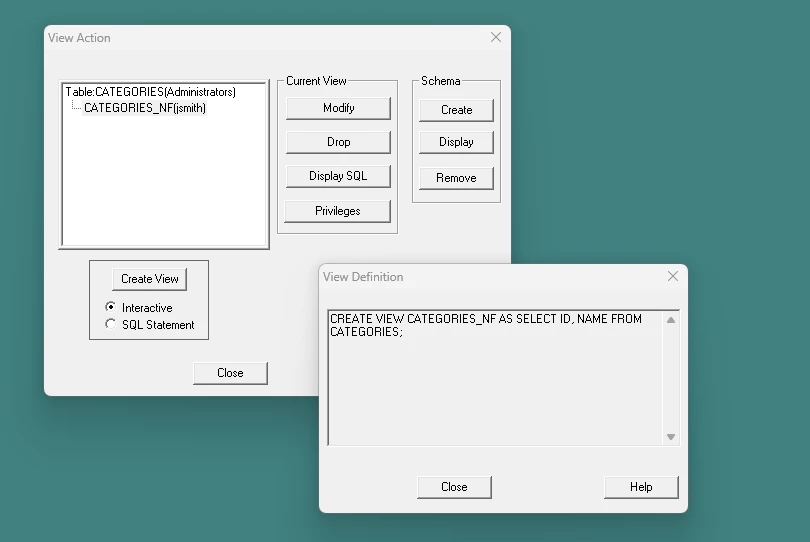
In Views for example, after you’ve created one, click on the Display SQL button … the commands are also covered in the UniData SQL Manuals.

 

8 replies

John Jenkins
Forum|alt.badge.img+1
  • Participating Frequently
  • April 10, 2026

Kevin,


You can save the command-line SQL used by VSG from the tool and build intoi a PAragraph.PROC or program to create schemas, views and permissions from the command line if tht helps?
 

I would not use CONVERT,SQL myself as it does not give fine control.

Regards

JJ


Kevin King
Forum|alt.badge.img+2
  • Author
  • Participating Frequently
  • April 10, 2026

That would be lovely, but… how do I know what command line SQL is being executed by VSG?


Jonathan Smith
Forum|alt.badge.img+4


In Views for example, after you’ve created one, click on the Display SQL button … the commands are also covered in the UniData SQL Manuals.


Kevin King
Forum|alt.badge.img+2
  • Author
  • Participating Frequently
  • April 13, 2026

Interesting, thank you!!


Kevin King
Forum|alt.badge.img+2
  • Author
  • Participating Frequently
  • April 13, 2026

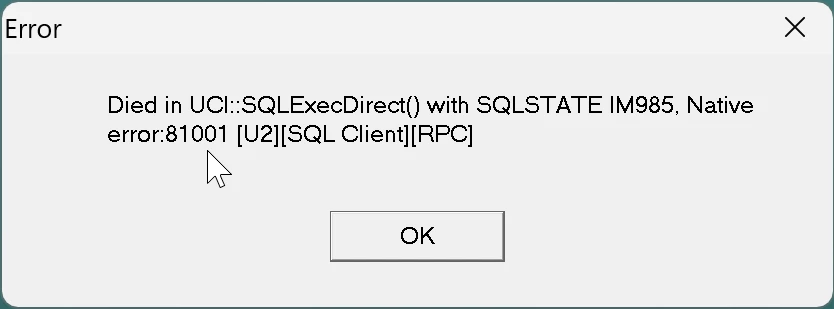
Any idea what this means?  It comes up when I click on Subtables.


John Jenkins
Forum|alt.badge.img+1
  • Participating Frequently
  • April 14, 2026

Kevin King
Forum|alt.badge.img+2
  • Author
  • Participating Frequently
  • April 14, 2026

It’s useful to be able to setup a new ud_database entry for testing.  Still doesn’t give me much in the way of answers as to why VSG is not working, but it definitely helps declutter the logs in the Unidata tmp directory.

My uci.config is fine.  It says UNIDATA and udserver where it should.

EUREKA.  Found the problem.  The permissions on this file were set before the last conversion, like a dozen years ago.  The Linux user IDs reflected in the privilege file no longer aligned with any valid user. I updated the privilege file to align with the Linux IDs and I am, as they say, back in business. 

Thanks for the help!


John Jenkins
Forum|alt.badge.img+1
  • Participating Frequently
  • April 15, 2026

Kevin,


That’s more common than you might think - and a reason I ALWAYS used a site-specific functional user name, high UID and specific GID when setting up ODBC and documented it - boldly - in my handovers along with a PAragraph that prompted and then dropped all views and schemas and then recreated them along with assigning group-based permissions - both physical and documented in detail..

I once wrote a utility to verify the views, schemas, users and privileges and report/fix any mismatch as it just kept on coming up and on large systems it was not feasible to d this manually.if the original SQL was not available (it rarely (if ever - was).. It’s useful to have such a program in your toolkit and it;s not difficult to work out the file layouts. On one particular customer site I was regularly back a couple of times a year fixing their schemas, views  and permissions.


ADDED: Changing FQDN on a domain can have a similar effect, even if the short name remains the same.

Regards