

Welcome
Dear Uniface Community,
Welcome to the February 2026 edition of the Rocket Uniface newsletter! As winter draws to a close, we’re excited to bring you the latest and greatest from the world of Uniface—where innovation, security, and community continue to propel us forward. This month’s issue is filled with product update highlights, including fresh features in the IDE, security enhancements, and refined installer experiences. Dive into our community resources, catch up on essential education around OpenTelemetry and code signing, and meet some of the passionate people driving Uniface’s ongoing evolution. Whether you’re a longtime developer or just getting started, we hope these updates, guides, and stories help you unlock even more value from Uniface. As always, thank you for being an essential part of our growing Rocket Uniface community!
Warm regards,
— The Uniface Team
Product Updates
- New Feature(s)
- The IDE Startpage now displays posts from the new Rocket Software Forum, helping you stay informed about the latest discussions, tips, and community updates without leaving your development environment.
- The DSP Widget Property Dialog in the IDE has been enhanced to make property management clearer and more flexible. You can now easily view which properties are defined for a specific widget type and modify them as needed. Additionally, you can assign an empty value to a property to override its default model definition.
- Currencies
- CURL has been upgraded to version 8.15.0 for improved security.
- New Feature(s)
- Revised legal notices in the Installer, IDE and Readme files.
Community, News, & Events
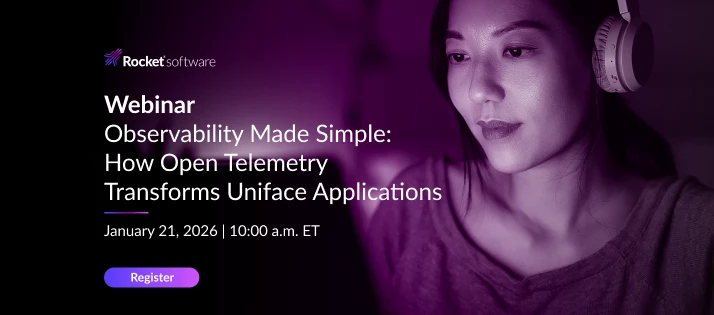
In Case You Missed It: Observability Made Simple: How OpenTelemetry Transforms Uniface Applications
The on-demand recording for this event is now available! In it, we covered:
-
Introduction to Observability in Uniface: Explore why observability matters for modern Uniface applications, especially in distributed and cloud-native environments.
-
Leveraging OpenTelemetry: Learn how OTEL can be integrated with Uniface to collect traces, metrics, and logs for deep visibility into application behavior and performance.
-
Real-world Implementation: See a live demo or walkthrough of instrumenting a Uniface application with OTEL, including exporting data to tools like Grafana or Jaeger.
-
Benefits for DevOps and SRE Teams: Understand how observability enhances incident response, root cause analysis, and continuous improvement in Uniface-based systems.
Watch Now
We Want to Hear From YOU, Rocket Forum Members! 🚀
Your voice is what keeps our community strong, vibrant, and constantly evolving. And now’s the perfect time to share it!
Our yearly member satisfaction survey is officially live, and we’ll be gathering your feedback over the next two weeks.
Whether you’ve been here from day one or you’re new, your input truly matters. Last year, your feedback played a huge role in shaping the Rocket Forum revamp, and many of the improvements you see today came directly from what you told us💡
Now, we’re ready to take the next step — with your help. Tell us what’s working, what could be better, and what you’d love to see next.
Thank you for sharing your thoughts. Let’s keep making Rocket Forum better, together ❤️
Education Resources
Announcement: New Code Signing Feature
Rocket has boosted security for its Uniface distributions by moving from GaraSign to its own internal code signing system. This change gives Rocket more control, improves standardization, and ensures the authenticity and integrity of your downloads. Starting with Uniface version 10.4.03-033, look for updated signature files and a new public key to verify your distributions. Want to know how to spot the changes and verify your software? Get the full scoop and step-by-step instructions in our latest blog post!
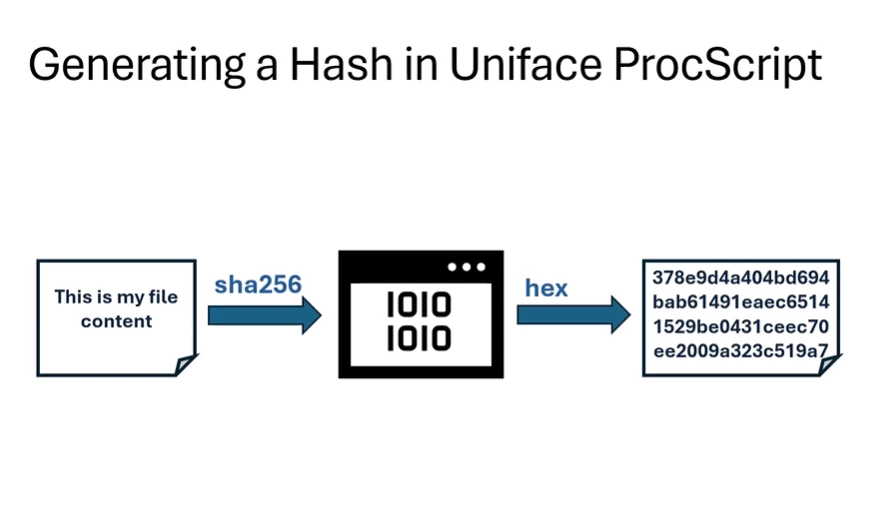
New Short: Generating a Hash using $encode
Watch a demo on how to create a Hash (Digest) using $encode in Uniface ProcScript so you can check if a file has been tampered with. Watch now.
Meet the Team
Jan Cees Boogard – Manager, Uniface Technical Support Engineering

What’s your role within Rocket Uniface, and what do you enjoy most about it?
I am responsible for Uniface Technical Support. What I enjoy most about this role is the direct contact with our customers and the opportunity to learn about the impressive solutions they have built with Uniface. Being able to help resolve technical issues when they arise gives me a real sense of pride.
What’s one Uniface feature or capability you think customers should know more about?
With my support hat on, I find the recently added OpenTelemetry access particularly exciting. Once it’s configured with the reporting tool of your choice, it can deliver highly valuable insights into the performance of any Uniface application. It has the potential to pinpoint where functional or performance issues originate, making troubleshooting faster and more precise.
What’s something fun or unexpected about you outside of work?
I enjoy listening to music on my hi‑fi system, and whenever time allows, I like to play my classical guitar. Outside of winter, my wife and I tend to our garden. I also love cooking dinner.
Support Corner
OAuth2 for Uniface (Frequently Requested by Users)
OAuth2 support in Uniface has become one of the most frequently asked‑for topics in the Uniface community, especially among developers integrating secure access to external email providers like Microsoft Outlook and Gmail. To address this recurring need, we’ve published a comprehensive technical guide explaining exactly how to implement OAuth2 within UPOPMAIL.
This article walks through the core OAuth2 building blocks—authorization grants, access and refresh tokens, scopes, and redirect flows—and demonstrates how these map to Uniface’s architecture. Developers will find detailed, implementation‑ready instructions, including required ASN file updates, TLS configuration, enabling the XOAUTH2 security driver, registering clients in Azure and Google Cloud, and handling redirect endpoints for authorization codes.
Beyond the theory, the guide provides step‑by‑step request/response examples for both Outlook and Gmail OAuth2 flows, illustrates how to inject tokens into UPOPMAIL via SetSecurity, and outlines common errors developers face when wiring OAuth2 into Uniface applications. Sample applications for both providers are also available to accelerate adoption.
👉 Check out the full technical article and sample apps