

DataEdge: Don’t just free your data. Empower it.
Recently active
The Tools for AI‑Ready Feeds with No Drama: The Complete RDRS-Powered Templates + KPI Starter Pack Want AI you can trust? Stop feeding it mystery data.Standardize your CDC feeds like products: owner + meaning + controls + SLAs + validation + ops.NOTE: This final step does not introduce new requirements.If you’ve worked through the earlier shifts—even for a single Tier‑1 feed—you already have everything you need. The Trusted Feed 1‑pager and KPI starter set simply assemble what you’ve already defined into one place, so you can answer a harder question with confidence: Is this a feed we trust enough to power AI?Trusted Feed 1‑pager (minimum fields): This 1‑pager is a practitioner‑owned contract (L2) that brings together what RDRS provides at the replication layer (L1) with validation, governance, and operations implemented downstream (L3).Source → target(s), pattern, tier Owner + on-call Keys + delete semantics + caveats (what the data means) SLAs (lag/success/errors/validation/recon) Ta
You’re not blocked by ideas—you’re blocked by reality.Fragmented systems, duplicated pipelines, and inconsistent data are what data teams deal with every day. They don’t just struggle to access data—they struggle to trust it, reconcile it, and use it without rework.As demands increase, from real-time operations to AI, those problems compound. Data arrives late, context is lost across handoffs, and decisions are made on incomplete or misaligned information. Instead of moving faster, teams spend more time rebuilding confidence in the data than acting on it.The challenge isn’t access. It’s consistency, trust, and timing—at scale.That’s where a more connected, governed approach to data becomes critical. Rocket DataEdge addresses these challenges by enabling discovery, access, delivery, and governance across systems—without forcing consolidation or duplication. This shift reduces rework, improves consistency, and makes it possible to move faster without losing control.Watch the webinar
Shift 5: Ops Guardrails — Production AI Needs Production Ops If It Pages at 3am, It’s telling you it needs guardrails, not better heroics. If your AI depends on CDC and your CDC depends on manual babysitting… your AI is not “production.” It’s a live demo with payroll.RDRS exposes the operational signals required to build guardrails (L1), but deciding what to alert on, who responds, and how recovery works is a practitioner responsibility outside of RDRS (L2), typically implemented using external monitoring and incident tooling (L3).What RDRS Contributes (Ops Guardrails)Operational signals (L1) Replication status End‑to‑end lag Apply / replication errors Replication controls (L1) Start / stop processes Restart after failure Controlled recovery Automation surfaces (L1) REST APIs for status REST APIs for process actions Failure characteristics (L1) Observable Restartable Diagnosable RDRS provides the signals and control surfaces; guardrails like alerting, runbooks, and escalation
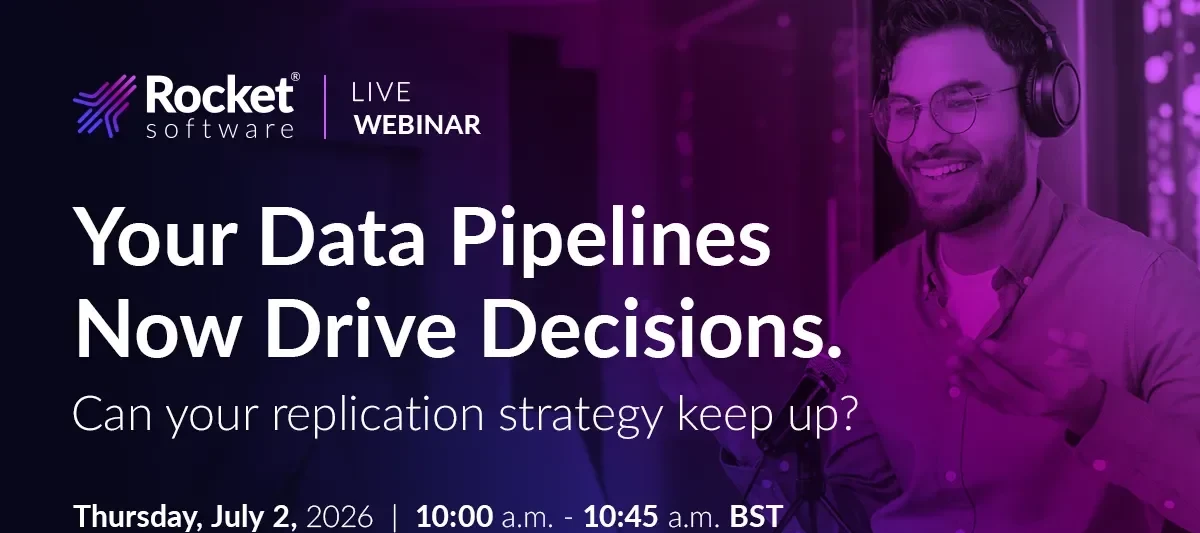
New RDRS WebinarThursday, July 2, 10:00 - 10:45am BSTData replication in the age of AI, ML, and real time analyticsData teams now spend 53% of their time just keeping pipelines running—not delivering new value. That’s time you don’t have.Real time is no longer a goal. It’s an expectation. Because your data pipelines don’t just move data anymore, they drive decisions. As AI and real-time analytics become the norm, data must be delivered with speed, accuracy, and accountability. Join us to learn how modern replication approaches help reduce risk, limit data sprawl, and deliver trusted, low-latency data across hybrid environments - without sacrificing control or cost.In this session, you’ll learn how to• Balance latency vs. consistency in real-world architectures• Choose between fan-out and point-to-point replication models• Design replay and recovery strategies for resilience• Use CDC pipelines to support AI and operational analytics without introducing unnecessary risk or co
Shift 4: Change-Resilient Pipelines — Meaning changes break AI faster than BI Why this shift matters: Even when RDRS correctly replicates schema changes (including DDL where supported), AI fails when change meaning, compatibility, and consumer impact are not explicitly managed—making change resilience a critical practitioner responsibility beyond CDC mechanics.Make Change Boring: Contracts, Versions, and Zero SurprisesBI complains when schemas change. AI hallucinates confidently when meanings change.Both are bad. One is sneakier.What RDRS contributes:Replicates DDL changes where supported (L1) Preserves change order and integrity at the mechanics level (L1) Ensures changes are not silently dropped during replication (L1)That’s it — and that’s enough.Minimum change resilience per Tier‑1 feed (L2)Document grain + keys + delete semantics (yes, really) Publish a simple change policy (who approves, timeline) Define evolution rules (new columns/type changes/renames) Version breaking changes
Shift 3: Sovereignty by Design — AI + Replicated Data Without Controls is the Fast Track to Compliance FinesCDC makes data accessible. AI makes it usable.That combo is powerful—and dangerous—without guardrails because you’ve just turned sensitive data into something that can be searched, summarized, and repeated everywhere—in seconds.What RDRS contributesSecure, controlled data movement (L1) Explicit source → target paths (L1)RDRS provides the mechanics of controlled data movement (L1); defining what is allowed, where data may land, and under what conditions is a practitioner responsibility outside of RDRS (L2). That responsibility is enforced through a small set of explicit sovereignty controls for AI‑critical feeds.Minimum sovereignty controls (Tier‑1 / AI-critical)Classify the feed (Public/Internal/Confidential/Restricted + PII flags) Enforce masking/tokenization downstream where required Ensure audit logging + retention exists at the target Define an exception/break-glass processPr
Shift 2: Standardize Bulk and CDC Patterns— Because AI at Scale Can’t Live on Bespoke FeedsIf Every Feed Is Special, None of Them Are ReliableAI doesn’t scale on bespoke feeds. It scales on repeatable patterns and a predictable operating model.Pick 2–3 RDRS-supported pattern familiesInitial bulk load followed by continuous CDC Capture once, replicate to multiple targets Continuous synchronization/coexistence patterns RDRS supports these replication patterns, but selecting which patterns are allowed and enforcing consistency across teams are practitioner responsibilities outside of RDRS. That consistency is enforced through an explicit feed‑level contract (L2)*.Standardize the “AI-ready contract” per feed (minimum)Keys + delete semantics Tier + SLAs (lag + correctness) Owner + on-call Validation bundle What changes trigger versioning Kill click-ops: Use RDRS REST API for light orchestration: automate routine tasks you currently click through in the dashboard (health/status checks, proc
Shift 1: Make CDC Trustworthy (SLAs + Validation) — Because AI Hates “Maybe Data”If your only metric is “job running,” your AI is training on hope and good intentions.So let’s start with the right signals. RDRS gives you deep operational information:Process status and lifecycle (L1) Latency, throughput, and replication statistics (L1) Error and failure reporting (L1)Trust starts by putting these on the scoreboard.Start with a handful of SLAs you can actually measure, then back them up with target-side validation that catches problems before your users (or your AI). These are the minimums to move from “it’s running” to “it’s reliable.”SLAs (pick 3–5): Defining and operating to these SLAs is a practitioner responsibility (L2); RDRS provides the signals needed to measure them.P95 end-to-end lag ≤ X minutes (AI use cases usually need tighter) Success rate ≥ Y% Apply errors ≤ Z/day Process restarts/day Time above lag thresholdThese are RDRS‑observable metrics.Target-Side Validation (Not Per
This series is written for data integration pipeline owners and practitioners who leverage Rocket Data Replicate and Sync (RDRS). While RDRS plays a critical role in that journey by providing high‑fidelity, observable replication mechanics, trusted enterprise data integration requires more than replication alone. It requires clear ownership, repeatable patterns, explicit contracts, operational guardrails, and disciplined interfaces with downstream platforms. It’s about everything it takes to deliver reliable, always‑on data integration at scale beyond “it worked in the demo.”To keep responsibilities clear, the series explicitly distinguishes between:What RDRS provides (replication mechanics, telemetry, and control surfaces) What data integration and CDC pipeline owners must define and operate around RDRS to make outputs trustworthy What is implemented downstream using non‑RDRS platforms and toolsEach post covers one of five shifts:Operational Trust: knowing what’s late, broken, or fall
Why are Data Integration Practitioners Feeling the Ground Shift?If your job includes being on call, you’ve already learned an important rule:Anything that only works in the demo will eventually page you.Usually at 2:47am…right after a “minor” upstream change…with the extremely helpful alert message:“job running”AI hasn’t changed that rule. It just made the blast radius bigger.Most AI failures don’t explode loudly. They quietly deliver outputs built on late, partial, or misunderstood data—and do it with complete confidence. When someone finally asks “can we trust this?”, the answer usually traces back to the same place it always has: The data pipelines everyone assumed were fine.Because you’re responsible for CDC-powered data integration and, unless you operate (or manage) Rocket® Data Replicate and Sync (RDRS) specifically—this should feel uncomfortably familiar. AI isn’t creating new problems. It’s dragging existing ones into the spotlight.This post isn’t a checklist or a tutorial. It
If your saved view name reads like a filing cabinet label, no one clicks it. Microcopy is your growth hack: name it like a button people want to press.The formula (keep it simple)Name pattern: [Emoji] [Job to be done] — [Scope or threshold] (Audience if needed) One‑liner: “Why this view exists” in one sentence. Action + payoff.Naming rules that earn clicksLead with the job, not the noun. Action beats category. Keep it under ~30 characters. Truncated names don’t get love. Use consistent emojis. Pick 6–8 and stick to them. Scope it. Add “>30d,” “High,” or “This Week” so expectations are clear. If it’s personal, say so. “(Me)” or “My Queue” prevents confusion.Your emoji shortlist (use sparingly)🔎 find/triage 🚩 risk/attention ✅ done/clean 🧹 cleanup/dedupe 💤 stale/aging 📥 imports ⚙️ ops/system 🧪 test/sandboxBefore/after names with one-linersBefore: Potential Duplicates After: 🧹 Needs Merge — High Why: Highest confidence dupes first; clear 5 in 5 minutes. Before: Validation Errors
It’s a privilege to post the very first message and personally welcome each of you. I’m Pat Kelly, marketing lead for the DataEdge suite of products.You’re here because you get it: Managing mission-critical data from core-to-cloud (and back) without the drama shouldn't be a nightmare of complexity, cost, or risk. That’s our shared mission, and this forum is your new launchpad. This is where the people who are actually doing it—your peers, our experts, and the sharpest minds in data replication, integration, and synchronization—hang out. Let's make your data strategy an unfair advantage!What You’ll Find Here (The High-Value Stuff)Forget endless manuals. We’re all about cutting straight to the solution and driving high-speed, high-value wins:The Cheat Codes (practical resources): You’ll get instant access to product updates, step-by-step how-tos, field-tested runbooks, and tuning tips—the exact patterns our solutions engineers use to save the day. The Squad (peer power): Connect directly
Join Michael Curry’s session (Tue 2:15 PM)If you’re attending the Gartner Data & Analytics Summit next week (March 9–11, 2026 | Orlando, FL), add this to your calendar:Michael Curry — “From Pilot to Production: 5 Shifts for an AI‑Ready Data Estate” Tuesday, 2:15 PMA lot of us have lived the same pattern: We get an AI pilot to work well in a demo, then it hits the “pilot-to-production wall”—when trust gets questioned, data and content don’t line up, controls become a blocker, and early wins stall.Michael’s session focuses on the practical shifts leading teams are making to move beyond the barriers—especially as LLMs and agent-style workflows become more common in real operations. Expect clear language, real-world framing, and a set of actions you can take back to your desk.Michael gives name and substance to the issues practitioners see every day:No measurable trust (quality debates happen after failures) Disconnected data and content (tables vs documents vs policies) Weak usage con
Rocket DataEdge just hit its one-year mark. The press release says “momentum,” “validation,” and “AI-ready.” Cool. But if you’re the person who owns pipelines, SLAs, access tickets, and the occasional 2 a.m. “why is the feed red?” message, the real question is: What changes for me?First: What does DataEdge do?In a nutshell, it makes all your data arrive while it still matters. DataEdge is an enterprise data integration platform built for the reality most of us live in:Core transactional data still lives on mainframe / legacy systems. Analytics, apps, and ML want that data in cloud / lakes / warehouses. The current solution is often a pile of ETL jobs, extra copies, and tribal knowledge.The value prop is: Deliver governed, near-real-time access to critical data across hybrid environments without melting the mainframe or creating 14 new “golden copies” no one can explain.Industry recognition: Should you care?DataEdge got nods from IDC (Vendor to Watch), Gartner (Honorable Mention), and s
Everyone’s racing on AI and analytics. Almost no one is feeding those engines with the best fuel they own—mainframe truth. That’s your opening. With DataEdge replication and synchronization (RDRS under the hood), you stream the good stuff from core to cloud without breaking prod, pin the lag graph near zero, and turn downstream teams into raving fans.Why you should careMainframe data isn’t “legacy”; it’s ground truth. When it lands in your lakehouse, warehouse, or Kafka streams, models get sharper and dashboards stop guessing. Execs don’t want slides; they want secure, explainable feeds that don’t spike MIPS or trigger audits. DataEdge is built for that job. You own the how. DataEdge is you kit to move it, serve it, and prove it — safelyWhat to build (and ship) with RDRSLog‑based Change Data Capture (CDC) pipelines: Capture mainframe Db2 changes and deliver to Kafka, cloud/object storage, lakehouse, or warehouses. Be surgical—tables, columns, and row filters only. Dev/test refresh on a
Already have an account? Login
No account yet? Create an account
Enter your E-mail address. We'll send you an e-mail with instructions to reset your password.
