



Powering Predictive Maintenance with Vertica ML:
From Downtime to Uptime

Sivan Tziring
Sr. Account Executive
Overview
Predictive maintenance has become a cornerstone of operational excellence across industries, particularly in environments where equipment uptime is mission-critical. Whether applied to healthcare systems, manufacturing machinery, or transportation networks, the ability to anticipate failures and address them proactively can lead to substantial improvements in cost efficiency, equipment lifespan, and service quality. At the heart of this innovation lies Vertica, a high-performance, scalable analytical database that empowers organizations to ingest, process, and analyze massive volumes of data to predict failures before they occur.
From Reactive to Predictive Maintenance
Traditionally, maintenance has followed a reactive model—machines break, and then repairs are made. This approach not only results in unexpected downtime but also disrupts operational schedules and burdens service teams with high-stress, time-sensitive tasks. Today, many industries are transitioning toward predictive models powered by real-time data, where potential issues are flagged and resolved before they cause disruptions.
This transition involves several key components:
• Remote Monitoring Infrastructure: Devices equipped with IoT capabilities continuously transmit performance data to centralized platforms.
• Advanced Data Integration: Historical logs, service records, sensor streams, and configuration data are ingested and correlated.
• Predictive Modeling: Machine learning models analyze patterns to detect anomalies, assess degradation, and trigger alerts.
• Service Optimization: Alerts guide field engineers or automated systems to take action,
Avoiding breakdowns and minimizing service interruptions.
Harnessing Vertica for Predictive Analytics
Vertica Supports the Entire Machine Learning Process:
- Data Preparation to ingest, join, aggregate, derive, structure, explore,
hypothesize, and clean iteratively at unlimited scale. - Modeling to create advanced models on massive datasets
with optimized MPP distributed algorithms via SQL - Evaluation for Model-level statistics, ROC tables, confusion matrices and Model health metrics
- Deployment in order to deploy quickly at any speed or scale with simple SQL calls
and for Model management and security.
In addition, Vertica serves as the backbone of many predictive maintenance systems by offering:
• Fast Ingestion of High-Volume Data: Vertica handles millions of events and sensor readings per day, per device. It supports real-time ingestion pipelines as well as historical data loading.
• Integrated Data Warehousing: Service logs, part replacements, system configurations, and sensor telemetry are stored and joined in a unified schema.
• Advanced Query Performance: With columnar storage, advanced compression, and projections, Vertica executes complex analytical queries with sub-second latency.
• Interoperability with Data Science Tools: Vertica natively supports Python and R, enabling data scientists to build, train, and deploy machine learning models directly within the platform.
Real-World Impact
In practice, Vertica enables organizations to transition from fragmented data silos to an end-to-end predictive maintenance pipeline. Consider a complex medical imaging device or an industrial robotic arm. These systems can weigh several tons, contain thousands of components, and operate around the clock. Failure of even a single part can cause significant service delays and financial losses.
With Vertica:
• Devices continuously stream telemetry and logs to a secure enterprise cloud.
• Data is parsed, structured, and stored in a centralized data warehouse.
• Models analyze temperature trends, power fluctuations, and error codes to forecast potential failures.
• Engineers receive alerts that are rich in context and evidence, enabling efficient triage and scheduling of maintenance.
• Insights are fed back into R&D to improve future device design.
Key Features Enabling Success
• Scalability: Systems scale to analyze tens of thousands of connected devices with terabytes of historical data.
• High Reliability: Robust error handling, built-in monitoring, and version-controlled ETL pipelines ensure consistent uptime and data quality.
• Rapid Deployment: Initial systems have been built from scratch to production within months, thanks to Vertica's simplicity and flexibility.
• Comprehensive Data Provenance: Each data point is traceable, improving transparency and trust in the analytics.
Beyond Alerts: Driving Business Value
The predictive insights generated through Vertica go far beyond issuing warnings. They support:
• Just-in-Time Parts Management: Aligning spare part inventories with predicted needs.
• Remote Troubleshooting: Reducing the need for onsite visits and enabling remote fixes.
• Reliability Engineering: Using real-world performance data to drive design enhancements.
• Customer Satisfaction: Offering more consistent service and reducing equipment downtime in critical environments.
Future Directions in Predictive Analytics
Organizations are exploring:
• Model Drift Detection: Automatically identifying when predictive models lose accuracy and need retraining.
• Active Learning: Prioritizing human intervention on data samples most valuable to model improvement.
• Anomaly Detection with Actionable Intelligence: Coupling anomaly alerts with specific, validated service recommendations.
How VERTICA Enables Predictive Maintenance
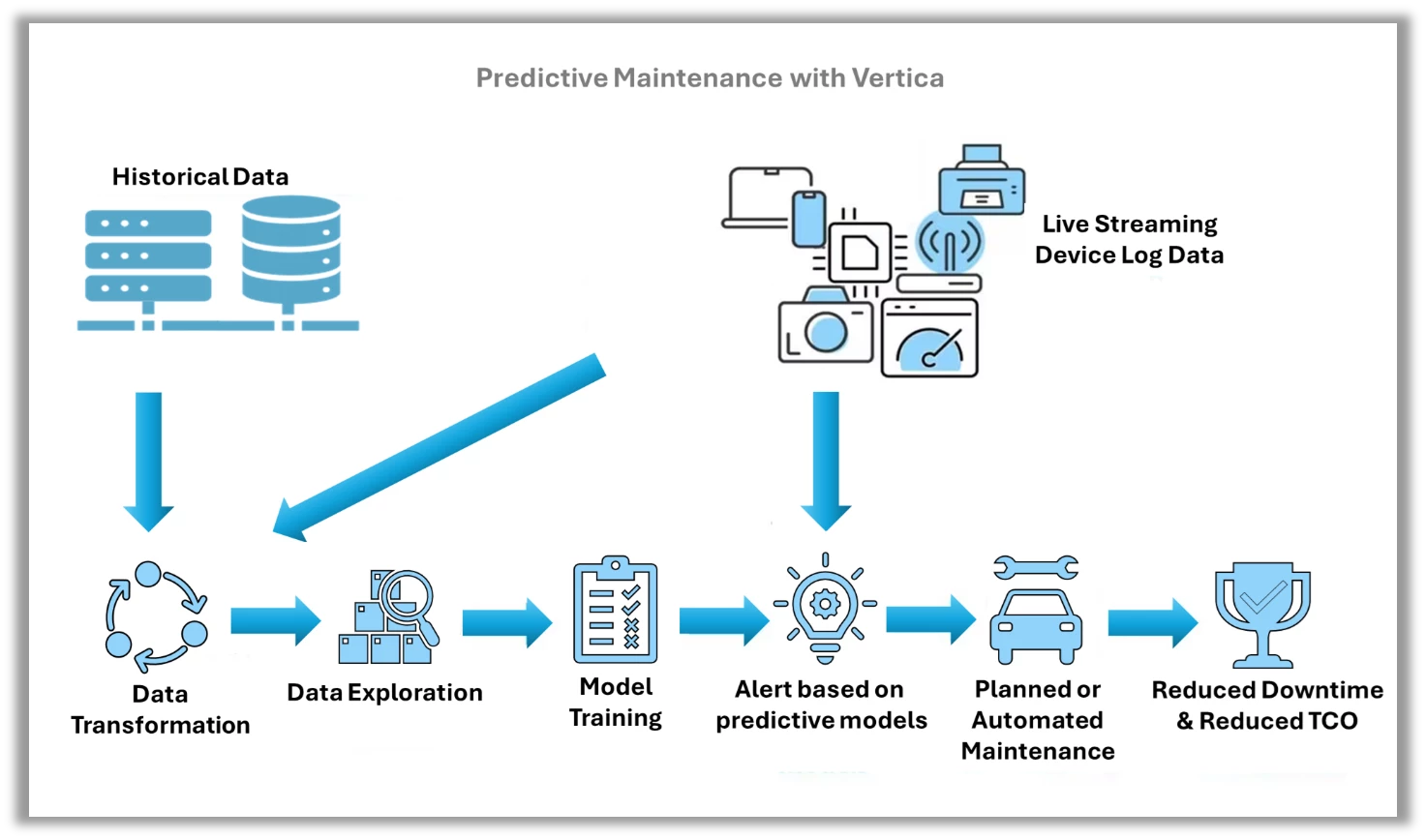
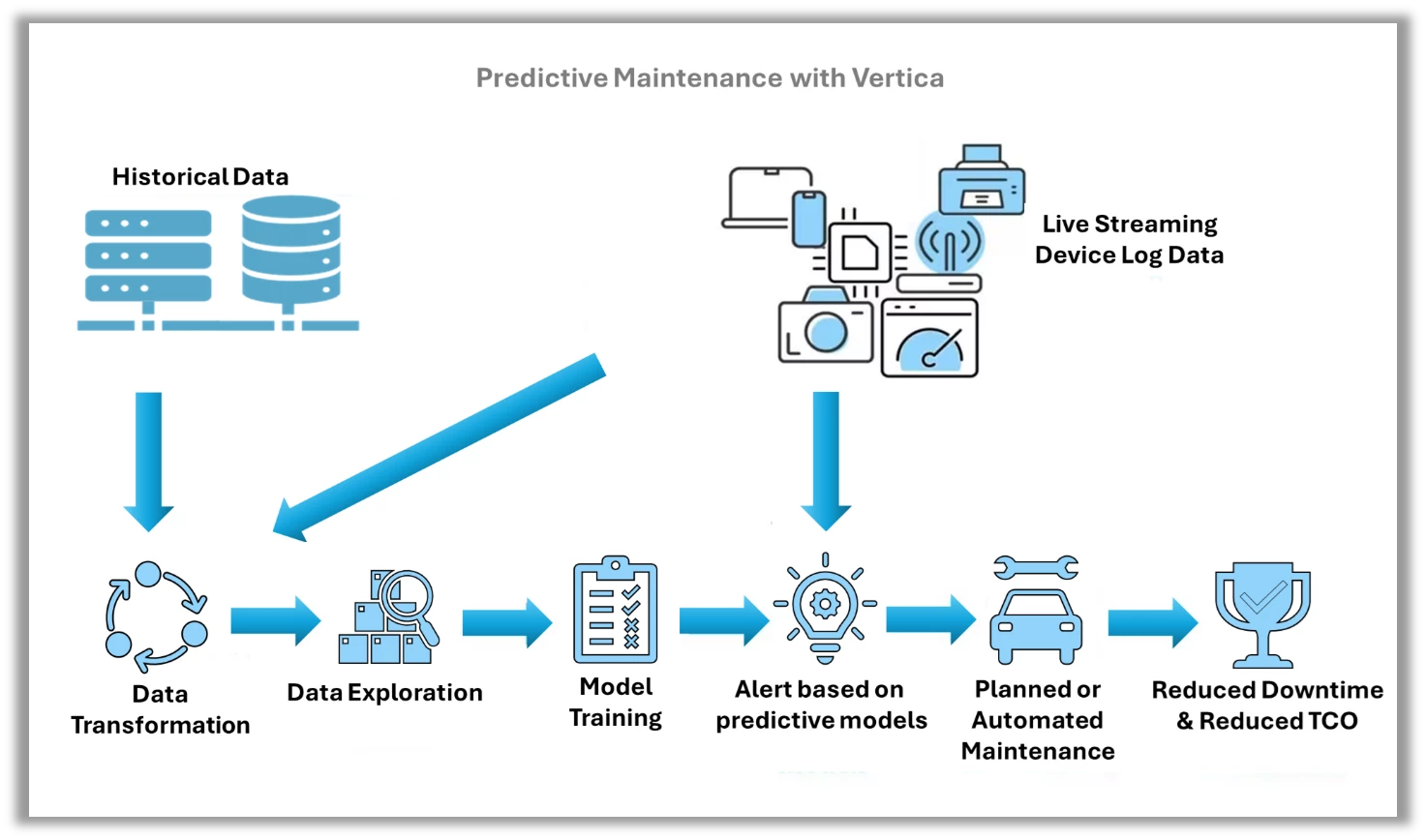
OpenText VERTICA Analytics Database can track and analyze vast streams of data from equipment components in real time. When simple statistical methods are adequate, the database performs these quickly and efficiently. With more than 800 built-in functions, it supports rapid execution of a wide range of analyses essential for predictive maintenance, including time series evaluation, pattern detection, and machine learning. In predictive maintenance using machine learning, historical data - like sensor readings and maintenance records - is stored in systems such as HDFS or S3. This data is used to train a machine learning model to detect signs of potential issues. As new data is continuously streamed from equipment, the model evaluates it to identify early warning signs. When it detects a possible issue, an alert is triggered, allowing maintenance teams to act proactively and prevent failures before they occur.